Why Rate Limiting Is Not Enough to Protect Your AI Chat Widget
· ·

Rate limiting is insufficient for protecting AI chat widgets because it only throttles the speed of requests, failing to stop "patient bots" that pace their activity to mimic human behavior while still consuming expensive LLM compute resources.
The Post-Hype Reality: Why Production-Hardening Matters More Than Model Training
The initial excitement of shipping an AI support agent often centers on the "fun" metrics: how well the model answers, how natural the tone feels, and how quickly it can be trained on internal documentation. However, the true competitive advantage in the current AI landscape isn't the model performance itself; it is the unglamorous, boring work of production-hardening. Once your widget is live on a public-facing site, the challenge shifts from "making it smart" to "keeping it sustainable."
At Gup, we have learned that the most significant threat to a production AI agent isn't a massive, headline-grabbing DDoS attack. Instead, it is the "silent tax" of low-frequency bot traffic that slips under the radar of standard security measures, quietly draining your budget and polluting your customer analytics.
The Rate Limiting Fallacy: Why Patient Bots Bypass Standard Throttling
Most developers implement rate limiting as a first line of defense. It is a standard, necessary practice: X messages per visitor, per minute, per IP. It effectively stops brute-force attempts and scripts that hammer an endpoint.
However, rate limiting is fundamentally a speed-based control. It assumes that the primary indicator of a bot is high-velocity activity. Modern, sophisticated bots are often "patient." By pacing their requests—sending one message every few seconds—they stay well below the threshold that triggers rate limits. These bots can remain active indefinitely, appearing to the system as a slow, steady stream of legitimate traffic.
The Hidden Compute Tax: How Automated Traffic Drains Your AI Budget
AI chat widgets are uniquely vulnerable compared to standard web forms or static pages. Every interaction with an AI agent triggers a call to a Large Language Model (LLM), which incurs a measurable compute cost.
When a bot interacts with your widget, you aren't just dealing with a standard web request; you are paying for the inference cost of every single message. If a bot sends thousands of messages over a 24-hour period, it acts as a direct, silent drain on your business's bottom line. Furthermore, this traffic fills your Inbox and Insights with noise, making it difficult for your team to distinguish between actual customer queries and automated garbage.
The Two-Layered Defense: Combining Throttling with Identity Gatekeeping
To secure a production AI environment, you must move beyond a single-layer approach. At Gup, we utilize a two-layered defense strategy:
- Layer 1: Throttling (Rate Limiting). This manages the speed of interactions, ensuring that no single entity—human or otherwise—can overwhelm your system with bursts of traffic.
- Layer 2: Identity Gatekeeping (Cloudflare Turnstile). This validates the legitimacy of the session before the widget even renders. It answers the question: "Is this a real browser being driven by a person?"
By layering these, you cover the entire threat surface. Rate limiting catches the fast, aggressive actors, while identity gatekeeping filters out the slow, patient bots that attempt to blend in.
How Cloudflare Turnstile Filters Bots Without Adding User Friction
One of the biggest concerns with security layers is the impact on user experience. Traditional CAPTCHAs are notorious for frustrating legitimate customers with "identify the traffic light" puzzles. Cloudflare Turnstile solves this by operating silently in the background.
It performs a series of non-intrusive checks to verify that the session is initiated by a browser. In the vast majority of cases, real users never see a challenge. The verification happens before the chatbot even renders its first message, ensuring that by the time a visitor starts typing, the system has already confirmed they are likely human. This creates a frictionless path for your customers while effectively blocking automated sessions.
The Invisible Win: Cleaner Analytics and Sustainable AI Operations
What happens once you implement these layers? The result is often less dramatic than expected—which is the goal. You won't see a spike in conversion rates overnight, but you will see the "noise floor" drop.
By eliminating the background hum of automated sessions, your Insights become clearer. You can finally see what real customers are actually asking, and your compute bill stops being inflated by non-human traffic. It is a win for both your operational efficiency and your data integrity.
A Checklist for Builders: Beyond the Demo
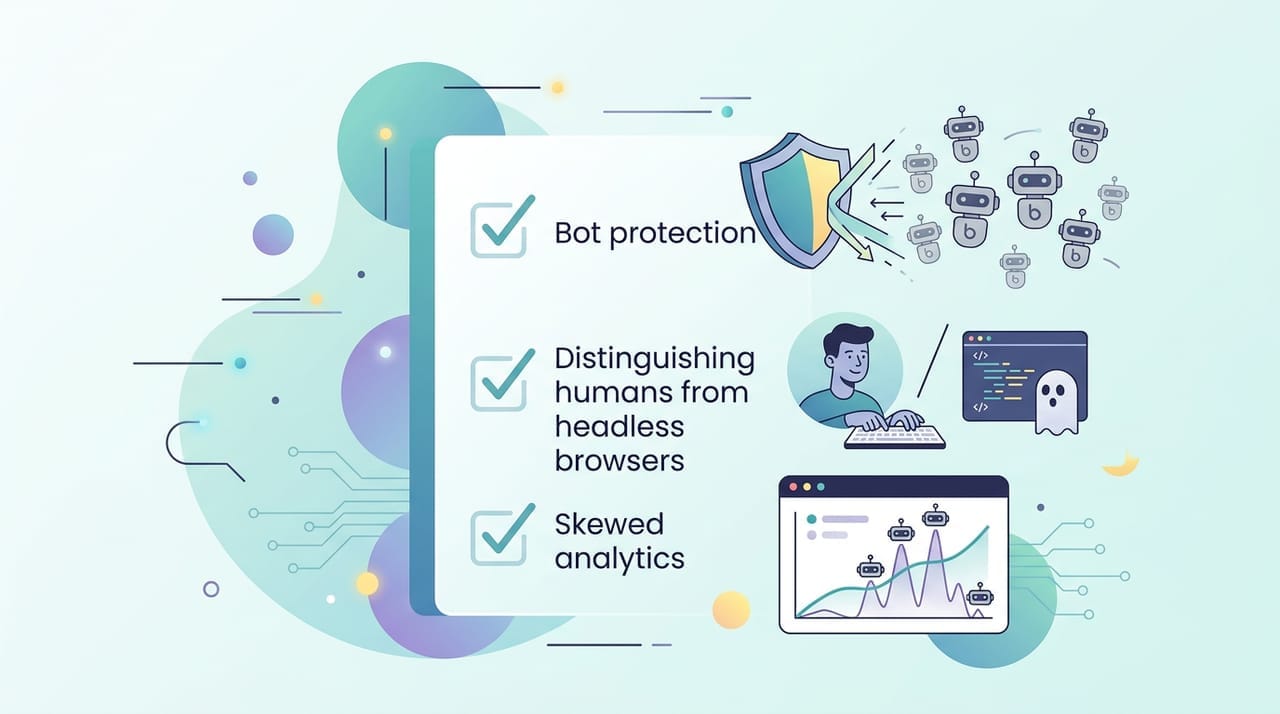
If you are evaluating or building an AI support agent, do not stop at the demo. Ask these questions before you go live:
- Is my widget protected against low-frequency bot traffic?
- How does my system distinguish between a human and a headless browser?
- Are my analytics currently being skewed by automated sessions?
Comparison: Security Measures for AI Chatbots
Scroll sideways to see all columns
Frequently Asked Questions
Why does AI chatbot traffic cost more than standard website traffic?
Standard web traffic involves serving static assets. AI chatbot traffic requires LLM inference for every message, which involves significant compute resources and API costs.
What is the difference between rate limiting and identity gatekeeping?
Rate limiting restricts the volume of requests over time, while identity gatekeeping verifies the nature of the requestor (human vs. bot) before the interaction begins.
Does Cloudflare Turnstile add friction for legitimate website visitors?
- Turnstile is designed to run silently in the background, only presenting challenges if it detects suspicious behavior, ensuring a seamless experience for real customers.
How can I tell if my AI agent is being targeted by bots?
Look for high volumes of "empty" sessions, repetitive or nonsensical queries, and traffic patterns that remain consistent 24/7 without corresponding increases in human activity.
Why is rate limiting alone insufficient for AI security?
Because bots can easily pace their requests to stay under your rate limits, allowing them to continue accessing your AI resources indefinitely while remaining undetected.